
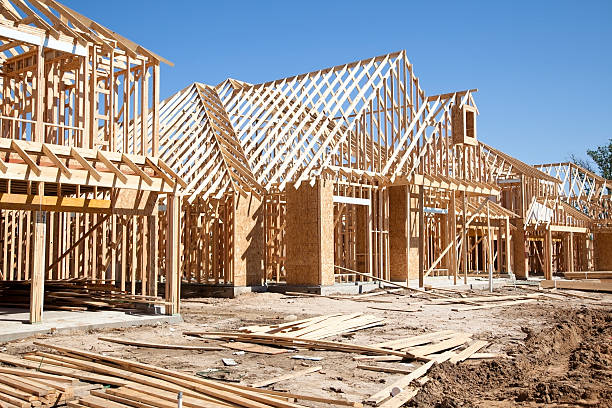
Canada’s housing market is currently within a slow, uneven adjustment. After the sharp run-up of 2020–2022 and a shaky comedown, the Canada Mortgage and Housing Corporation (CMHC) now expects national home prices to drift slightly lower in 2025 (roughly a 2% decline, with bigger drops in expensive provinces like Ontario and B.C.) before a gradual recovery later in the decade [5]. Recent data shows how volatile conditions are: housing starts (residential construction projects initiated) fell 16% in August 2025, then rebounded 14% in September. Developers are still reacting to financing costs, economic uncertainty, and shifting demand [7]. At the same time, CMHC estimates Canada needs 430,000 - 480,000 new homes per year through to 2035. This almost doubles recent building levels. To get affordability back to roughly 2019 conditions, this highlights a structural supply gap rather than a short-term blip [5].
In response to this, recent federal and provincial policies have focused on financing more construction and cutting red tape. Budget 2025 put housing at the center of economic policy, with nearly $25 billion in allocated new housing measures. This includes roughly $13 billion over five years for the new Build Canada Homes initiative, which is meant to coordinate programs and accelerate delivery using more efficient construction methods such as modular and factory-built housing [2].
A key financial lever is the expansion of Canada Mortgage Bonds (CMBs). Ottawa is raising the annual issuance cap from $60 billion to $80 billion starting in 2026, with the extra $20 billion earmarked for CMHC-insured multi-unit rental projects. In theory, this is aimed at unlocking thousands of new apartments by lowering borrowing costs for builders [5].
Provinces, particularly Ontario, are using legislation to push projects through faster. Bill 17, the Protect Ontario by Building Faster and Smarter Act, 2025, received Royal Assent in June 2025. The bill amends a suite of laws, from the Building Code Act to the Planning Act and City of Toronto Act, to speed approvals, facilitate transit-oriented development, and limit some municipal rules that can slow or add cost to new housing [1][6].
In combination, these decisions aim to expand supply by making multi-unit projects easier to finance and quicker to approve, rather than directly slashing prices. Whether they succeed will depend on execution: CMHC’s latest supply-gap report stresses that solving the crisis still requires higher productivity in construction, more labour, and sustained investment over many years, not just one budget or one bill.
Sources:
[1] https://www.blg.com/en/insights/2025/05/ontario-introduces-bill-17-to-build-faster-homes-communities-and-transit-infrastructure
[2] https://bsh.ubc.ca/budget-2025-our-analysis-of-build-canada-homes-and-housing-investments/
[3] https://budget.canada.ca/2025/report-rapport/chap3-en.html
[4] https://www.canadianmortgagetrends.com/2025/11/budget-2025-doubles-down-on-housing-strategy-but-adds-few-new-measures/
[5] https://www.cmhc-schl.gc.ca/observer/2025/summer-update-2025-housing-market-outlook?
[6] https://www.ola.org/en/legislative-business/bills/parliament-44/session-1/bill-17
[7] https://www.reuters.com/world/americas/canadian-housing-starts-fall-16-august-cmhc-2025-09-16/
In response to this, recent federal and provincial policies have focused on financing more construction and cutting red tape. Budget 2025 put housing at the center of economic policy, with nearly $25 billion in allocated new housing measures. This includes roughly $13 billion over five years for the new Build Canada Homes initiative, which is meant to coordinate programs and accelerate delivery using more efficient construction methods such as modular and factory-built housing [2].
A key financial lever is the expansion of Canada Mortgage Bonds (CMBs). Ottawa is raising the annual issuance cap from $60 billion to $80 billion starting in 2026, with the extra $20 billion earmarked for CMHC-insured multi-unit rental projects. In theory, this is aimed at unlocking thousands of new apartments by lowering borrowing costs for builders [5].
Provinces, particularly Ontario, are using legislation to push projects through faster. Bill 17, the Protect Ontario by Building Faster and Smarter Act, 2025, received Royal Assent in June 2025. The bill amends a suite of laws, from the Building Code Act to the Planning Act and City of Toronto Act, to speed approvals, facilitate transit-oriented development, and limit some municipal rules that can slow or add cost to new housing [1][6].
In combination, these decisions aim to expand supply by making multi-unit projects easier to finance and quicker to approve, rather than directly slashing prices. Whether they succeed will depend on execution: CMHC’s latest supply-gap report stresses that solving the crisis still requires higher productivity in construction, more labour, and sustained investment over many years, not just one budget or one bill.
Sources:
[1] https://www.blg.com/en/insights/2025/05/ontario-introduces-bill-17-to-build-faster-homes-communities-and-transit-infrastructure
[2] https://bsh.ubc.ca/budget-2025-our-analysis-of-build-canada-homes-and-housing-investments/
[3] https://budget.canada.ca/2025/report-rapport/chap3-en.html
[4] https://www.canadianmortgagetrends.com/2025/11/budget-2025-doubles-down-on-housing-strategy-but-adds-few-new-measures/
[5] https://www.cmhc-schl.gc.ca/observer/2025/summer-update-2025-housing-market-outlook?
[6] https://www.ola.org/en/legislative-business/bills/parliament-44/session-1/bill-17
[7] https://www.reuters.com/world/americas/canadian-housing-starts-fall-16-august-cmhc-2025-09-16/
Thanks for reading!
Share this article if you found it helpful and inspiring.
Published by CORDAX Team
© 2026 CORDAX. All rights reserved.